
How to Become a DevOps Engineer in 2026
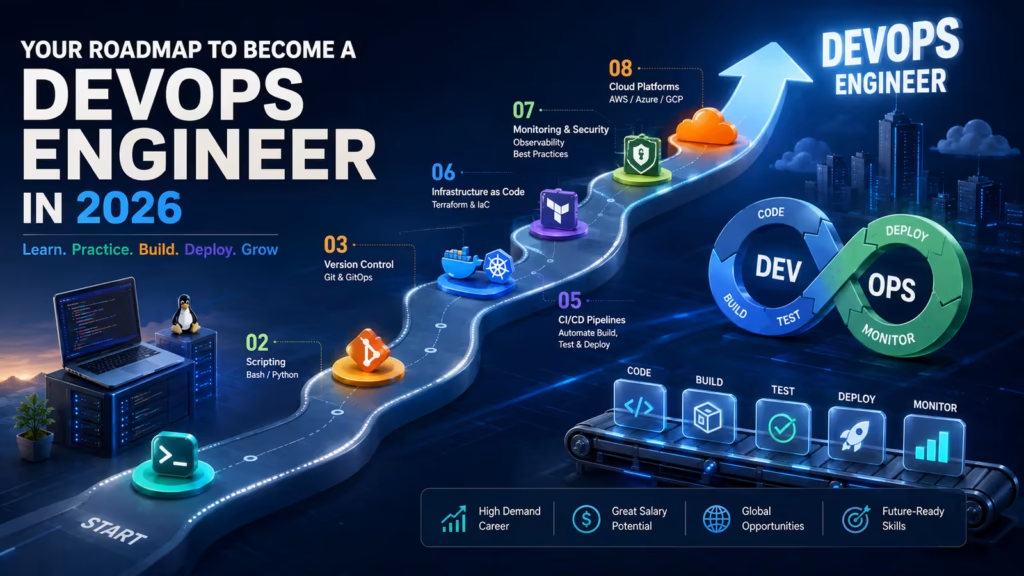
The path to becoming a DevOps engineer in 2026 is more structured than it was five years ago, but it still rewards engineers who combine technical breadth with genuine curiosity. DevOps is not a single tool or certification — it is a mindset backed by a specific set of technical skills. This guide lays out exactly what you need to learn, in what order, and what the job actually looks like in practice today.
What Does a DevOps Engineer Actually Do?
A DevOps engineer sits at the intersection of software development and IT operations. The core responsibility is to make the process of building, testing, and releasing software faster, more reliable, and more automated. In practical terms, this means setting up and maintaining the infrastructure that developers deploy code to, building the pipelines that automate testing and deployment, and ensuring that systems stay healthy and observable in production.
On any given day, a DevOps engineer might write infrastructure-as-code to provision a new cloud environment, investigate why a deployment pipeline is failing, optimize a Kubernetes cluster’s resource usage, or set up alerting rules for a new microservice. The role is highly varied, which is part of what makes it demanding and rewarding at the same time.
The Foundation: Linux and Networking
Before touching any DevOps tool, you need solid Linux skills. Nearly all server infrastructure runs on Linux. You should be comfortable navigating the file system, managing processes, editing files from the command line, understanding file permissions, and writing basic shell scripts.
Equally important is networking fundamentals. DevOps work involves configuring firewalls, load balancers, virtual private clouds, DNS records, and SSL certificates. You do not need to be a network engineer, but you must understand how IP addresses, subnets, ports, HTTP, TCP/IP, and DNS resolution work. Without this foundation, cloud networking configurations will feel like guesswork.
Practical steps to build this foundation:
- Install Ubuntu Linux in VirtualBox and practice daily administration tasks from the terminal.
- Complete the Linux command line basics course on any major learning platform.
- Study the first three chapters of any CCNA networking textbook to understand networking concepts without going into certification depth.
Learn a Scripting Language: Python or Bash
Automation is the backbone of DevOps work, and automation requires scripting. Bash scripting is essential for working directly with Linux systems — writing deployment scripts, automating backups, processing log files, and triggering system commands in pipelines. Every DevOps engineer needs to be comfortable reading and writing Bash.
Python has become the preferred language for more complex DevOps automation. It is used for writing custom CI/CD pipeline steps, working with cloud provider APIs, parsing configuration files, and building monitoring integrations. Python’s readability and the extensive ecosystem of libraries make it highly productive for infrastructure automation tasks.
You do not need to reach advanced software engineering level in either language. For DevOps work, you need to be able to write functional scripts that solve infrastructure problems reliably.
Version Control with Git
Git proficiency is non-negotiable for a DevOps engineer. All code — including infrastructure code — lives in Git repositories. You need to understand branching strategies, merging, rebasing, resolving conflicts, tagging releases, and working with remote repositories on GitHub or GitLab.
DevOps engineers interact with Git differently from developers. Beyond committing code, you configure branch protection rules, set up repository webhooks that trigger CI pipelines on push events, and manage access controls on repositories at the organization level. Understanding GitOps — where the entire desired state of your infrastructure is stored in Git and synchronized automatically to your cluster — is increasingly important in 2026.
Containers: Docker and Kubernetes
Container technology is central to how DevOps engineers deploy software in 2026. You need to understand Docker deeply — how to write Dockerfiles, build and push images, manage volumes and networks, and use Docker Compose for local multi-container environments.
Kubernetes knowledge is equally expected at mid-level and senior DevOps roles. You should be comfortable writing deployment and service manifests, configuring ingress controllers, setting up horizontal pod autoscalers, managing ConfigMaps and Secrets, and troubleshooting failing pods using kubectl commands.
Hands-on practice is the only effective way to learn both. Set up a local cluster using Minikube or Kind, or use a free tier of a managed Kubernetes service on a cloud platform.
CI/CD Pipelines: The Heart of DevOps
Building and maintaining CI/CD pipelines is one of the most core responsibilities of a DevOps engineer. A CI/CD pipeline automates the steps between a developer pushing code and that code reaching production. Typical stages include code checkout, running unit tests, building a Docker image, running integration tests, pushing the image to a registry, and deploying it to the target environment.
The most commonly used CI/CD tools in 2026 are Jenkins, GitHub Actions, GitLab CI, and CircleCI. GitHub Actions has seen massive adoption in recent years because of its tight integration with GitHub repositories and its large marketplace of prebuilt workflow actions.
Start by building a simple GitHub Actions workflow that runs tests and builds a Docker image. Then add deployment stages and approval gates. Understanding pipeline design at this practical level is what separates candidates who get hired from those who do not.
Infrastructure as Code: Terraform and Ansible
Infrastructure as Code (IaC) means defining your cloud infrastructure — servers, databases, networks, load balancers — in code files that can be version controlled, reviewed, and applied consistently. This eliminates manual infrastructure configuration and makes environments reproducible.
Terraform is the leading IaC tool in 2026. It works across AWS, Azure, GCP, and dozens of other providers using a single declarative language. You write what infrastructure you want, and Terraform figures out how to create, update, or destroy it to match your definition.
Ansible is a configuration management tool used to install software, configure settings, and manage the state of servers after they are provisioned. While Terraform creates the infrastructure, Ansible configures what runs on it. Learning both gives you a complete infrastructure automation toolkit.
Cloud Platform Knowledge
Every DevOps role in 2026 requires working knowledge of at least one major cloud platform. AWS holds the largest market share and is the most commonly required in job listings. Azure is dominant in enterprise Microsoft-stack environments. GCP is popular in data-intensive and AI-focused companies.
You do not need to master all three. Pick one and learn it thoroughly. For AWS, focus on EC2, S3, VPC, IAM, EKS, RDS, and CloudWatch. These services appear in nearly every DevOps job using AWS. Earning the AWS Certified DevOps Engineer certification significantly strengthens your professional profile.
Monitoring, Logging, and Observability
Deploying software is only half the job. You also need to know whether it is working correctly in production. Monitoring and observability tools are how DevOps engineers answer that question.
The most common monitoring stack in 2026 is Prometheus for metrics collection combined with Grafana for visualization. For log management, the ELK Stack — Elasticsearch, Logstash, and Kibana — remains widely used, alongside newer tools like Loki and Grafana for cloud-native log aggregation.
Understanding how to define meaningful alerts — ones that notify teams of real problems without creating constant noise — is a skill that distinguishes experienced DevOps engineers from beginners. An alert that triggers constantly gets overlooked. An alert that fires too rarely misses real outages. Setting the right thresholds requires understanding normal application behavior, which comes from spending time with the data your systems produce.
DevOps Salaries and Career Outlook in 2026
DevOps engineering remains one of the highest-compensated technology roles globally. In India, junior DevOps engineers earn between four and eight lakh rupees annually. Mid-level engineers with two to four years of hands-on experience earn ten to eighteen lakh. Senior DevOps engineers and platform engineers command twenty-five lakh and above at established technology companies.
The demand for DevOps professionals continues to outpace supply in 2026. Companies across banking, e-commerce, healthcare, and SaaS are hiring aggressively. Engineers who combine strong cloud skills with Kubernetes and CI/CD expertise are particularly sought after. Remote DevOps roles are also increasingly common, which opens the global job market to candidates regardless of location.
Start Your DevOps Career Today
Join WhaleCourse Technologies for affordable training with hands-on projects and placement support.
Conclusion
Becoming a DevOps engineer in 2026 is achievable for anyone willing to invest consistently in the right skills. The journey starts with Linux, moves through Git, scripting, Docker, and CI/CD, and grows into cloud platforms, Kubernetes, and monitoring. Each skill you add makes the next one easier to learn because DevOps tools are deeply interconnected.
Do not wait until you feel fully ready before applying for roles. Build a portfolio of real projects on GitHub — a Terraform module that provisions a cloud environment, a GitHub Actions pipeline that deploys a Dockerized application, a Kubernetes manifest set for a multi-service application. These projects demonstrate applied knowledge better than any certification alone.
The market for DevOps engineers remains strong and shows no signs of slowing. If you invest ten months in building the skills described in this guide, you will be genuinely competitive for entry-level and junior DevOps positions at technology companies.
In This Article
Enroll in Our IT Courses
Master IT Program at whalecoursetechnologies
- Expert Mentorship from IT Professionals
- Job-Ready Skills with Live Projects
- Career Boost Add-on Modules
- 100% Placement & Interview Support