
Automation Tester Roadmap: From Manual Testing to Selenium Automation
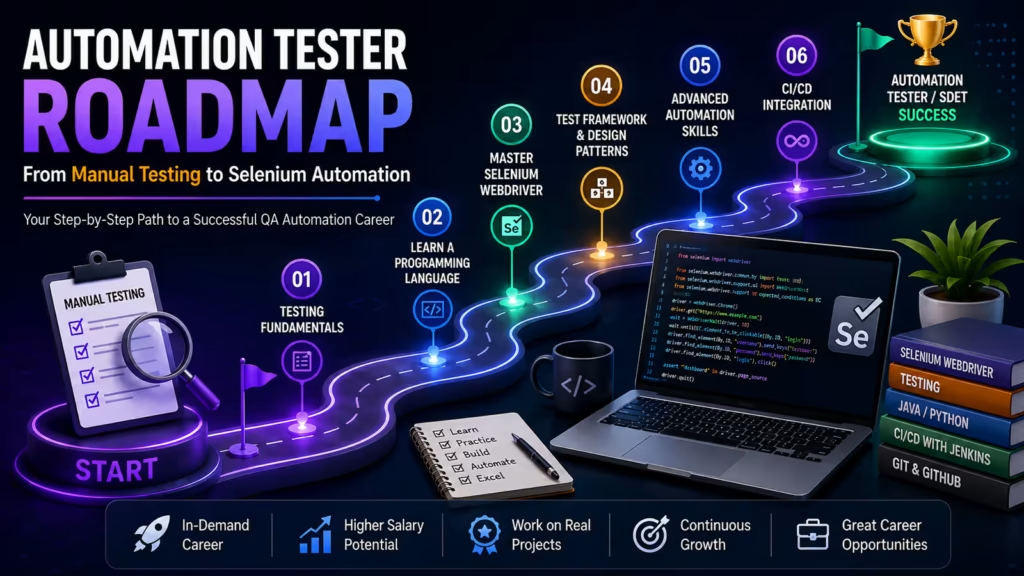
The automation tester roadmap has become one of the most searched career topics among quality assurance professionals who want to grow beyond manual testing. Manual testing is a valuable starting point, but the industry has clearly shifted toward automation. Companies expect testers to write code, build test frameworks, and integrate automated checks into deployment pipelines. This guide maps out the exact path from where you are now to where you need to be.
Why Manual Testers Should Learn Automation
Manual testing is not going away entirely, but its scope is shrinking. Agile and DevOps delivery cycles are now measured in days rather than weeks. Teams release multiple times per week, sometimes multiple times per day. Running a complete manual regression suite on every release is physically impossible at that pace. Automation is what makes rapid deployment safe.
Beyond speed, automation enables consistent execution. A human tester gets tired, skips steps under deadline pressure, and makes judgement calls. A Selenium script runs the same test exactly the same way every single time. Consistency is especially critical for regression testing, where the goal is to verify that nothing working yesterday has broken today.
Manual testers who add automation skills to their profile typically see salary increases of forty to sixty percent. More importantly, they become candidates for senior QA engineer, automation lead, and SDET roles that are significantly higher compensation than pure manual testing positions.
Step 1: Strengthen Your Testing Fundamentals
Before writing your first automated test, your manual testing knowledge needs to be solid. Automation is a layer on top of good testing — it does not replace the thinking. If you do not know how to identify test conditions, write effective test cases, and understand what constitutes a pass or fail, your automated tests will be automated bad tests.
Core testing knowledge every automation tester must have:
- Understanding test types: unit, integration, system, acceptance, and regression testing
- Writing test cases from requirements and user stories
- Techniques like boundary value analysis, equivalence partitioning, and decision table testing
- Understanding defect life cycles and how to write clear bug reports
- Basic understanding of software development life cycle and Agile methodology
If you have been working as a manual tester, you likely have most of this already. Use it as your foundation rather than something to rush past.
Step 2: Learn a Programming Language
Writing automated tests requires writing code. There is no way around this. The most common languages used in test automation are Java, Python, and JavaScript. Each has its strengths depending on the team and technology stack.
Java is the most widely used language for Selenium automation in enterprise environments. The Java ecosystem has mature testing libraries like TestNG and JUnit, and most corporate QA job postings mention Java as required or preferred.
Python is the easiest language to learn for someone coming from a non-programming background. The syntax reads like plain English, and pytest is an excellent testing framework. Python is very popular in automation roles at product companies and startups.
JavaScript is a strong choice if your team is testing JavaScript-heavy front-end applications. Tools like WebdriverIO and Playwright are built for the JavaScript ecosystem.
Pick one language and commit to it. Trying to learn multiple languages simultaneously slows your progress. You can learn a second language after you have real automation experience with your first.
Step 3: Master Selenium WebDriver
Selenium WebDriver is the industry-standard tool for browser automation testing. It communicates directly with browsers through their native automation protocols, making it the most reliable option for testing web applications across different browsers and operating systems.
Start with the Selenium WebDriver basics: launching browsers, finding elements using locators, clicking buttons, typing in input fields, and reading text from elements. Then move to more advanced topics:
- Locator strategies — ID, name, CSS selector, XPath, link text, and partial link text. CSS selectors are generally faster and more readable than XPath for most situations.
- Waiting strategies — implicit waits, explicit waits with WebDriverWait and ExpectedConditions. Never use Thread.sleep in production test code.
- Handling pop-ups and alerts — switching between windows, handling JavaScript alert dialogs, and working with iframes.
- Taking screenshots — capturing screenshots on test failure for debugging.
- Managing cookies and sessions — useful for pre-authenticating tests to skip login flows.
Step 4: Learn a Test Framework and Design Patterns
Writing individual Selenium scripts is a starting point, not a destination. Professional automation testers organize their code into maintainable frameworks. The most important design pattern to learn is the Page Object Model, commonly called POM.
Page Object Model means creating a separate class for each page or component of your web application. That class contains the locators for elements on that page and methods that perform actions on those elements. Your test cases then call methods from these page classes rather than directly interacting with elements.
This separation provides two major benefits. First, when the UI changes — which it always does — you update only the relevant page class instead of hunting through dozens of test scripts. Second, your test code becomes readable like a story: loginPage.enterUsername, loginPage.enterPassword, loginPage.clickLogin. Anyone can understand what the test is doing without needing to read complex Selenium code.
Combine POM with TestNG or JUnit in Java, or pytest in Python, to run test suites, generate reports, and handle test data through parameterization and data providers.
Step 5: Add API Testing to Your Skill Set
Automation testers who only know UI automation have a narrow skill set. API testing is faster, more reliable, and can catch bugs at an earlier layer than UI tests. The best automation tester roadmap includes both.
REST API testing involves sending HTTP requests to application endpoints and verifying the responses — status codes, response body content, response time, and headers. Postman is the most popular tool for manual API exploration and can also be used for automated API test collections. For code-based API automation, RestAssured in Java and the requests library in Python are the most widely used frameworks.
Understanding API testing also makes you a better UI automation tester. When a UI test fails, knowing how to check the underlying API often helps you quickly determine whether the bug is in the front end or the back end.
Step 6: Integrate Tests into CI/CD Pipelines
Automation tests that only run when a tester manually triggers them provide limited value. Their real power comes from running automatically on every code change. This is what CI/CD integration achieves.
You need basic knowledge of at least one CI/CD tool — Jenkins, GitHub Actions, or GitLab CI. Configure your pipeline to check out your test repository, install dependencies, run your Selenium test suite against the deployed application, and publish test results as pipeline artifacts.
For Selenium tests in CI, run browsers in headless mode. Headless mode means the browser runs without a visible window, which works correctly in server environments that have no display. Chrome and Firefox both support headless execution and are the standard choice for CI pipeline testing.
Common Mistakes New Automation Testers Make
Learning from common mistakes saves you weeks of frustration. These are the errors that most beginners make when following an automation tester roadmap.
- Automating everything immediately — not every test case benefits from automation. Focus automation effort on stable, repetitive, high-value test cases first. Tests that check constantly changing UI should remain manual.
- Using XPath everywhere — XPath locators that navigate the DOM structure break every time a developer restructures the page. Prefer ID, data-testid, or CSS class locators where available.
- Skipping the Page Object Model — writing all test code inline works for small experiments. For anything maintained over time, lack of POM creates unmaintainable spaghetti code.
- Ignoring test flakiness — tests that sometimes pass and sometimes fail for no clear reason destroy team trust in the test suite. Flaky tests must be fixed immediately, not ignored.
- Not version-controlling test code — your test code is production code. It must live in a Git repository with proper branching, code review, and history.
What to Expect in Automation Tester Job Interviews
Automation tester interviews typically combine testing knowledge questions with live coding exercises. You should be prepared to explain the Page Object Model, write a Selenium script from scratch during a technical screen, and demonstrate understanding of test frameworks and CI/CD concepts.
Common interview questions include: how would you handle a dynamic element that does not have a stable ID, what is the difference between implicit and explicit waits, how do you make test data independent between test cases, and describe the structure of a test framework you have built.
Build a real automation portfolio on GitHub before you start applying. A repository containing a Selenium framework with POM, parameterized tests, API test scripts, and a CI/CD pipeline configuration demonstrates more than a list of skills on a resume ever can.
Start Your Automation Testing Career Today
Join WhaleCourse Technologies for affordable training with hands-on projects and placement support.
Conclusion
The automation tester roadmap is a gradual, buildable journey. It starts with reinforcing your testing fundamentals, moves into programming skills, and progresses through Selenium, framework design, API testing, and CI/CD integration. Each stage builds directly on the one before it.
The engineers who succeed on this path are not necessarily the ones who learn fastest. They are the ones who practice consistently, build real projects, and do not skip the design fundamentals. A poorly structured test framework is worse than no framework at all — it creates maintenance debt that eventually collapses under its own weight.
Give yourself six to nine months of focused learning and hands-on project building. By the end of that period, you will have the skills, the portfolio, and the confidence to make a real transition from manual testing into a Selenium automation role that offers better pay, more interesting work, and significantly stronger long-term career prospects.
In This Article
Enroll in Our IT Courses
Master IT Program at whalecoursetechnologies
- Expert Mentorship from IT Professionals
- Job-Ready Skills with Live Projects
- Career Boost Add-on Modules
- 100% Placement & Interview Support