
Top DevOps Tools Every Engineer Must Learn in 2026
Welcome to our comprehensive guide on the most important software development technologies today. If you want to build a successful career in the tech industry, knowing the right tools is absolutely essential. One of the biggest topics right now is the list of DevOps Tools Every Engineer Must Learn. In 2026, the technology landscape has grown incredibly fast, and mastering these tools can open the door to amazing job opportunities. DevOps is a combination of development and operations, and it helps teams build, test, and release software faster and more reliably. Whether you are still in high school, just starting your college degree, or looking to switch careers, understanding these tools will give you a massive advantage. We have put together this easy-to-read guide to help you learn everything you need to know without getting confused by complicated jargon. So, let us dive into the wonderful world of automation and see how these tools can transform your coding journey!
By the time you finish reading this article, you will have a clear understanding of the fundamental concepts, why they are so valuable, and exactly which DevOps Tools Every Engineer Must Learn to stay ahead of the competition. Let us start our exciting learning adventure together right now.
Why Are DevOps Tools Important?
Before we talk about the specific tools, we need to understand why DevOps is so famous in the first place. Imagine you are building a massive LEGO castle. If you work alone, it might take you weeks to finish it. But if you have a team of friends helping you, and everyone knows exactly what part they need to build, you can finish it in just a few hours. That is basically what DevOps does for software development. It brings people together and gives them the right system to work fast.
One of the biggest reasons why you need the DevOps Tools Every Engineer Must Learn is that they eliminate boring, repetitive work. Instead of manually copying files or running the same tests over and over again by hand, you can use these tools to automate the entire process. This saves thousands of hours of human effort and makes sure fewer mistakes happen. When computers do the repetitive tasks, humans can focus on being creative and solving difficult problems. Furthermore, these tools help companies release new updates to their apps in minutes rather than months. Think about your favorite mobile game. When it gets a cool new feature or a bug fix, that happens quickly because the developers use DevOps tools behind the scenes to push those updates straight to your phone seamlessly.
Another major benefit is reliability. If something breaks in a traditional system, it can be very hard to find out why. With the right DevOps practices, systems are monitored around the clock. If an error occurs, the team gets an instant alert, and they can fix the problem before the users even notice it. This results in happier customers and less stressful work environments for the engineers.
Core Categories of DevOps Tools Every Engineer Must Learn
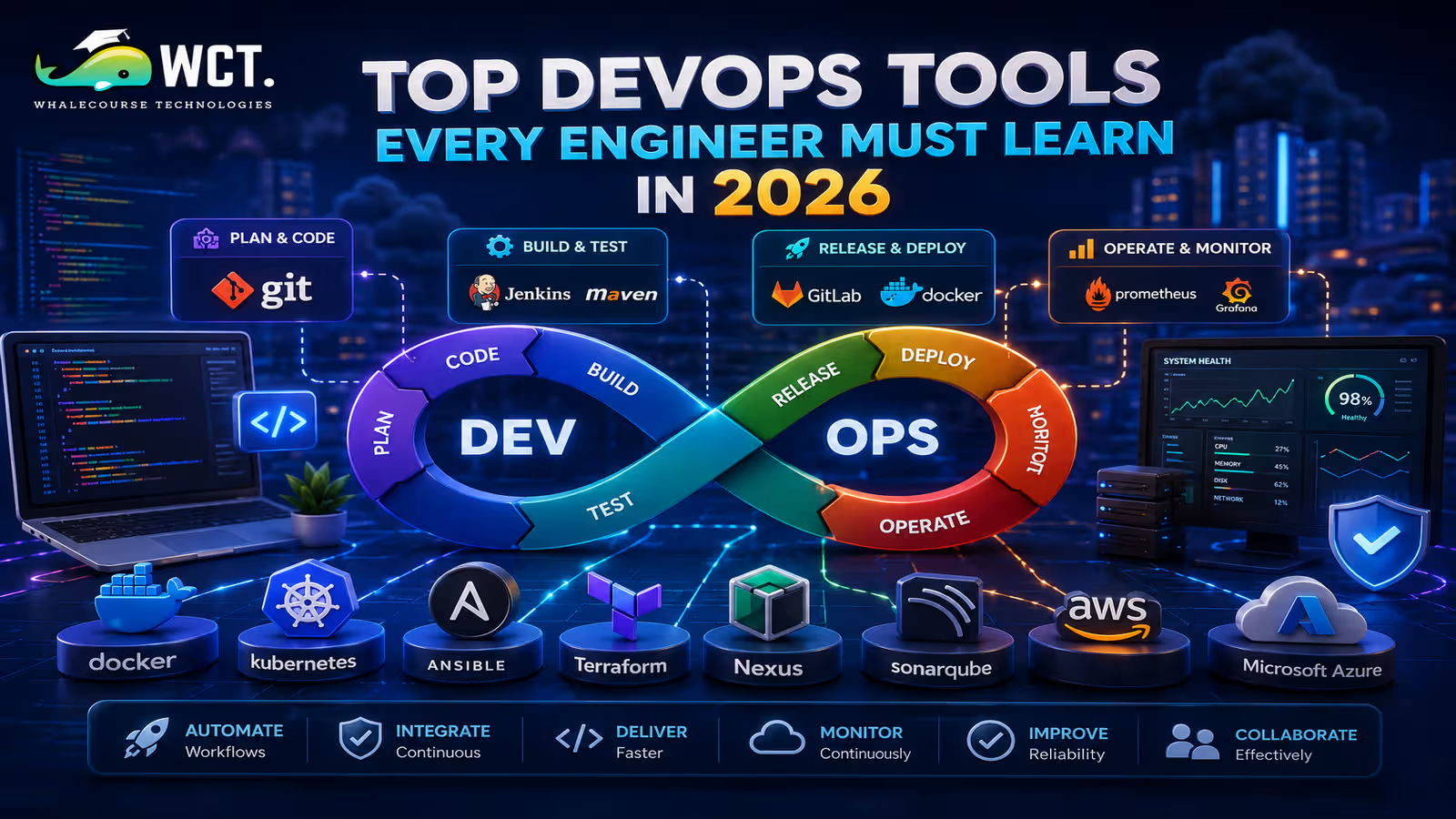
To understand DevOps more easily, it helps to group its tools into a few major categories. Think of them as different departments in a factory. First, you have planning and coding. This is where teams decide what features to build and write the actual code. Second, you have building and testing. Once the code is written, it needs to be compiled into a working application and tested for any annoying bugs. Third, you have releasing and deploying. This means sending the finished app out into the real world for people to use on their devices or web browsers. Finally, you have operating and monitoring, which means keeping a close eye on the software to ensure it is running smoothly and fixing it quickly if it crashes. Each of these categories has a specific set of tools. When you combine them all, you get what engineers call a “pipeline.” Let us look at the top DevOps Tools Every Engineer Must Learn in each of these exciting categories.
Git: The King of Version Control
If there is one tool that absolutely everyone in the software industry uses, it is Git. Git is a version control system. Imagine you are writing a very long essay for school. Every time you make a change, you might save it as a new file, like “essay_final.doc”, then “essay_really_final.doc”, and so on. This gets messy very quickly. Git solves this problem beautifully by keeping track of every single change you make to your files automatically.
If you accidentally delete an important piece of code, Git allows you to travel back in time and restore it instantly. This makes experimenting completely safe. You can try new ideas without the fear of ruining your working project. Git also allows dozens or even hundreds of people to work on the exact same project at the same time without overwriting each other’s work. Popular platforms like GitHub and GitLab are built on top of Git, providing a visual interface for teams to collaborate, review code, and share their creations with the open-source community. If you are starting your journey, Git is the first tool you must learn.
Docker: Mastering Containerization
Have you ever tried to play an old computer game, only to find out it does not work on your new operating system? This happens because software depends on specific environments to run properly. Docker fixes this massive problem by using something called “containers.” A container is like a magic box that holds your application and everything it needs to run properly, including libraries, system tools, and settings.
Because the container has everything inside it, you can take that box and run it on any computer in the world, and it will work exactly the same way. It does not matter if you are using a Windows laptop, a Mac, or a massive Linux server in the cloud; Docker ensures your software behaves consistently. This consistency makes development and deployment much more reliable, as applications behave the same across different environments. Since Docker is lightweight, multiple containers can run efficiently on a single machine without placing a heavy load on system resources. It is undoubtedly one of the most powerful DevOps Tools Every Engineer Must Learn today.
Kubernetes: Managing Containers at Scale
Docker is amazing for running a few containers, but what happens when you work for a giant company like Netflix or Spotify? You might need to run thousands or even millions of containers at the same time. Managing all of those manually would be impossible. That is where Kubernetes comes in to save the day. Kubernetes is an orchestration tool, which means it acts like the conductor of an orchestra, making sure all the different parts play together perfectly in harmony.
If one of your containers crashes or stops working, Kubernetes automatically notices it and starts a brand new one to take its place. When your application experiences a sudden increase in traffic, Kubernetes can automatically launch additional container instances to keep performance stable and ensure users continue to have a smooth experience. Once the visitors leave, it scales everything back down to save you money on server costs. Learning Kubernetes can be a little challenging at first, but it is an incredibly valuable skill that top tech companies are desperately looking for in 2026.
Jenkins: The Heart of Automation
Jenkins is like a tireless robot assistant that works for you twenty-four hours a day. It is an open-source automation server that helps teams implement Continuous Integration and Continuous Deployment (commonly called CI/CD). In simple terms, every time a developer finishes writing a new piece of code and saves it, Jenkins instantly wakes up and takes action. It automatically builds the code, runs hundreds of automated tests to check for errors, and if everything is perfect, it can even deploy the code straight to the live website.
Before tools like Jenkins existed, teams would have to manually run these tests, which could take hours or even days. With Jenkins, the whole process happens in a few minutes. It has a massive library of plugins, meaning it can connect with almost any other software tool on the market. While there are newer CI/CD tools available today, Jenkins remains a cornerstone of the industry because of its flexibility, making it a critical part of the DevOps Tools Every Engineer Must Learn.
Terraform: Infrastructure as Code
In the past, setting up a server for a website meant buying physical hardware, plugging in cables, and manually installing operating systems. Even with cloud computing, you still had to click through dozens of menus to configure everything correctly. Terraform changes all of that by introducing a concept called “Infrastructure as Code” (IaC). With Terraform, you do not click buttons. Instead, you write simple code to describe exactly what kind of servers, databases, and networks you need.
After your configuration is ready, Terraform applies it to your chosen cloud platform, such as Amazon Web Services or Microsoft Azure, and provisions the required infrastructure automatically. When you want to deploy the same environment in a different region, you can simply reuse the same configuration. This approach saves time, delivers consistent results, and minimizes mistakes that often occur during manual setup. However, a small challenge with Terraform is that you have to be careful; deleting a line of code might accidentally delete an important database. Despite this, its power makes it essential for modern engineering.
Prometheus: Monitoring and Alerts
Once your application is running in the real world, you cannot just close your laptop and hope for the best. You need clear visibility into how your systems and applications are performing at all times. Prometheus is a fantastic open-source monitoring tool that constantly collects data (called metrics) from your servers and applications. It tracks things like how much memory is being used, how fast the website is loading, and how many users are currently online.
If something goes wrong, for example, if the server is running out of space, Prometheus will instantly trigger an alert and send a message to the engineering team so they can fix it before the website crashes completely. Teams often pair Prometheus with a tool called Grafana, which takes all that raw data and turns it into beautiful, easy-to-read charts and graphs. Monitoring is the key to keeping software healthy, making Prometheus a vital skill.
Benefits and Challenges of DevOps
Adopting these amazing tools brings tremendous benefits. Teams can work faster, software becomes much more reliable, and companies can deliver new features to their users rapidly. The collaboration between different departments improves significantly because everyone uses the same tools and processes. However, there are also some challenges to be aware of. The biggest challenge is the steep learning curve. There are so many tools to learn, and they change rapidly. Sometimes, it can feel overwhelming for a beginner. Additionally, setting up these automated systems requires a lot of effort upfront before you start seeing the benefits. But do not worry! Take it one step at a time, and you will eventually master them all.
Future Trends in DevOps for 2026
As we look at the year 2026, the world of software is evolving in exciting ways. One of the biggest trends is the integration of Artificial Intelligence into DevOps tools. We are seeing AI systems that can automatically detect security vulnerabilities in your code before you even test it. There are also smart tools that can predict when a server is likely to crash based on historical data. Another major trend is called “GitOps,” which takes the ideas we learned about Git and applies them to managing the entire infrastructure automatically. Furthermore, security is becoming a massive priority, leading to a new term called “DevSecOps,” where security checks are built into every single step of the development process from day one.
How to Start Learning These Tools Today
If you are feeling excited and want to start learning, the best approach is to get your hands dirty and practice. You do not need to spend money to learn these tools. Most of the DevOps Tools Every Engineer Must Learn covered in this guide are open-source, so you can download, install, and use them without paying any licensing fees. Start by installing Git on your computer and creating a free account on GitHub. Learn how to save your files and track changes. Then, install Docker and try running a simple web server inside a container.
There are countless free tutorials, YouTube videos, and interactive courses available online designed specifically for beginners. The secret to success is consistency. Try to spend just thirty minutes every day building small, fun projects. Over time, all these concepts will click together in your mind, and you will feel confident using them in a professional environment.
Start Your Data Analytics Career Today
Join WhaleCourseTechnologies for affordable training with hands-on projects and placement support.
Conclusion
In conclusion, the world of technology is moving faster than ever before, and staying updated is the key to a long and successful career. We have explored a wide variety of tools, from Git for tracking changes, to Docker and Kubernetes for managing containers, and Terraform for automating infrastructure. We also looked at Jenkins for CI/CD and Prometheus for keeping our systems healthy. These are undeniably the core DevOps Tools Every Engineer Must Learn in 2026 to stand out in the job market.
Remember, nobody learns all of this overnight. Every senior engineer was once a beginner who felt confused by all these new terms. Be patient with yourself, keep experimenting, and do not be afraid to make mistakes. Mistakes are just learning opportunities in disguise. Start your journey today, and before you know it, you will be building incredible, automated systems that power the software of the future. Good luck, and happy coding!
In This Article
Enroll in Our IT Courses
Master IT Program at whalecoursetechnologies
- Expert Mentorship from IT Professionals
- Job-Ready Skills with Live Projects
- Career Boost Add-on Modules
- 100% Placement & Interview Support