
Complete Guide to AWS Certification Path in 2026
If you’re planning to start a career in cloud computing, learning the AWS Certification Path 2026 is the ideal first step. Amazon Web Services (AWS) remains the world’s leading cloud platform, and organizations across industries continue to seek professionals with AWS certifications. This guide explains the available AWS certifications, the recommended order to earn them, and how each certification can help you secure your first cloud role or advance your existing career.
What Is AWS Certification?
AWS Certification is a globally recognized credential from Amazon Web Services that confirms your cloud computing knowledge and practical skills. When you earn an AWS credential, it signals to employers that you have been tested against real-world standards set by the company that built the platform.
These certifications are not just resume decorations. They reflect practical competency. Hiring managers treat them as shorthand proof that you can actually do the work, which is why they have become some of the most sought-after credentials in the entire IT industry.
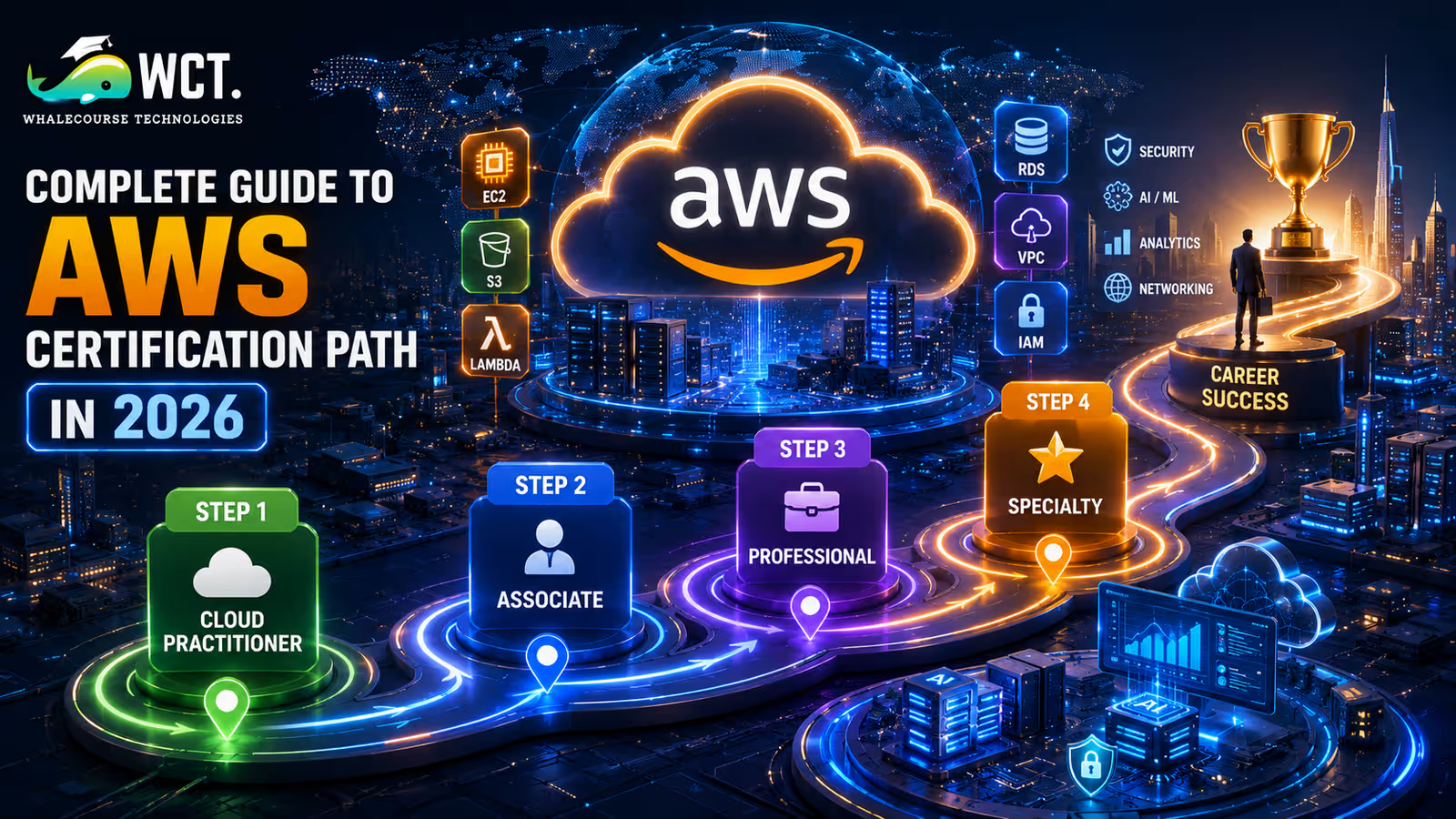
AWS divides its certifications into four skill levels: Foundational, Associate, Professional, and Specialty. Each level targets a different experience range and job role.
AWS Certification Path 2026: The Full Roadmap
Here is how the AWS certification journey looks in 2026, organized from entry level to expert level. Follow this sequence and you will build knowledge that actually stacks rather than collecting disconnected credentials.
Step 1: AWS Certified Cloud Practitioner (CLF-C02)
This is the starting point for everyone new to AWS, regardless of technical background. The Cloud Practitioner exam tests your understanding of core cloud concepts, AWS global infrastructure, basic security principles, and billing practices. You do not need hands-on experience to pass this exam, but reading the AWS documentation and taking a few practice tests will give you a significant advantage. Most candidates prepare in four to six weeks. This foundational credential makes it much easier to have meaningful conversations with technical teams even if you are in a non-technical role.
Step 2: AWS Associate Level Certifications
The Associate tier is where your career really begins to gain traction. There are three paths at this level, and which one you pursue depends on your job goals.
AWS Solutions Architect Associate (SAA-C03) is the most popular AWS certification in the world. It teaches you how to design reliable, scalable cloud applications. If you want to become a cloud architect or cloud engineer, this is the exam to take first at the Associate level. It covers compute, storage, databases, networking, and security design patterns.
AWS Developer Associate (DVA-C02) targets professionals who write and deploy code on AWS. It focuses on Lambda, API Gateway, DynamoDB, and deployment tools like CodePipeline and CodeDeploy. This path suits developers who want to build cloud-native applications.
AWS SysOps Administrator Associate (SOA-C02) focuses on operating and managing AWS environments. Monitoring, automation, cost optimization, and incident response are the core topics. This is the right path if you are already in a systems administration or DevOps role.
Step 3: AWS Professional Level Certifications
Professional level certifications are significantly harder and require real hands-on experience to pass. These exams assess your ability to design complex, multi-service architectures and make cost, performance, and security trade-offs under realistic constraints.
AWS Solutions Architect Professional (SAP-C02) is considered one of the most challenging cloud certifications available. It builds on everything from the Associate level and pushes you into large-scale system design territory. Expect lengthy scenario-based questions that require deep service knowledge.
AWS DevOps Engineer Professional (DOP-C02) covers infrastructure automation, monitoring at scale, high availability design, and deployment strategy. It suits engineers who bridge the gap between development teams and operations teams.
Step 4: AWS Specialty Certifications
Specialty certifications are advanced AWS credentials designed for professionals who want to build expertise in specific technical domains. They are best pursued after earning at least one Professional-level certification and gaining hands-on industry experience. AWS offers Specialty certifications in areas such as Advanced Networking, Security, Machine Learning, Data Analytics, Database, and SAP on AWS. These certifications demonstrate deep technical knowledge and help professionals qualify for high-demand, specialized cloud roles with strong career growth and competitive salaries.
How to Prepare for AWS Exams in 2026
Preparing smartly matters more than just studying long hours. Here is a preparation approach that consistently works for AWS candidates.
- Use the official AWS Exam Guide for your target exam. It lists every domain and its weight. Build your study plan around it.
- Take a structured video course. Platforms like A Cloud Guru, Udemy, and Whizlabs offer regularly updated content aligned with current exam versions.
- Use the AWS Free Tier to practice hands-on. Reading about EC2 is useful. Actually launching an EC2 instance and configuring security groups is irreplaceable.
- Take practice exams under timed conditions. Aim to score consistently above 85 percent before booking your real exam. AWS passing scores sit around 72 percent.
- Read the AWS Well-Architected Framework. This document underpins many exam questions at the Associate and Professional levels and is freely available on the AWS website.
AWS Certification Career Opportunities and Salary
AWS certifications open doors to some of the highest paying jobs in IT. The demand for certified AWS professionals continues to grow as more organizations migrate workloads to the cloud.
Entry-level cloud support roles typically start at three to four lakh rupees annually in India for freshers with the Cloud Practitioner credential. Associate-level certified professionals working as cloud engineers or solutions architects commonly earn between six and twelve lakh rupees. Professionals holding the Solutions Architect Professional or DevOps Engineer Professional certifications in senior roles regularly see packages between fifteen and twenty-five lakh rupees or more, depending on the organization and location.
Common job titles you can pursue along the AWS Certification Path 2026 include Cloud Support Associate, Cloud Engineer, Solutions Architect, DevOps Engineer, Cloud Security Engineer, and Cloud Infrastructure Specialist.
Common Mistakes to Avoid
Many AWS candidates fail their first attempt because of avoidable errors. Skipping hands-on practice in favor of memorizing dumps is the most common. AWS exams are scenario-based, meaning they test judgment, not just recall. Memorized answers from brain dumps rarely translate to passing scores on modern AWS exams.
Another frequent mistake is jumping straight to Associate level without solidifying foundational concepts. Spending an extra two weeks on Cloud Practitioner material saves far more time than struggling through Associate prep with weak fundamentals.
Finally, neglecting the Shared Responsibility Model, IAM policies, and pricing models costs many candidates dearly. These topics appear across all AWS exam levels and deserve consistent attention throughout your study plan.
Future Trends in AWS Certification
AWS continues updating its certifications to reflect evolving cloud workloads. In 2026, the most notable shifts are toward generative AI, machine learning operations, and cloud security. The AWS AI Practitioner certification introduced recently reflects this direction. Candidates who combine cloud architecture knowledge with AI service familiarity will find themselves in an especially strong hiring position over the next several years.
Multi-cloud skills are also growing in demand. Pairing your AWS certification with basic Azure or Google Cloud knowledge makes you more attractive to large enterprises that operate across multiple providers. This does not mean pursuing certifications on all three platforms simultaneously, but understanding the conceptual differences between providers adds genuine value to your professional profile.
Start Your Cloud Career Today
Join WhaleCourseTechnologies for affordable training with hands-on projects and placement support.
Conclusion
The AWS Certification Path 2026 is one of the clearest and most rewarding professional journeys available in the IT field. Starting with the Cloud Practitioner gives you a solid foundation. Moving through the Associate certifications builds genuine technical skill. Advancing to Professional and Specialty credentials separates you from the majority of candidates in the job market.
What matters most is consistent practice. Reading alone will not pass AWS exams. Build things on the free tier. Break them. Fix them. That cycle of hands-on experience is what turns exam knowledge into professional competence that employers actually value.
Choose your first certification, set a realistic study schedule, and commit to it. The AWS certification journey rewards patience and persistence more than raw intelligence or prior experience.
In This Article
Enroll in Our IT Courses
Master IT Program at whalecoursetechnologies
- Expert Mentorship from IT Professionals
- Job-Ready Skills with Live Projects
- Career Boost Add-on Modules
- 100% Placement & Interview Support