
How to Use AI for Content Marketing and SEO
AI for content marketing has transformed the way businesses create, optimize, and publish content. In 2026, marketers use AI-powered tools to speed up SEO research, generate high-quality content, improve search rankings, and increase productivity without sacrificing quality. This guide explains how to use AI effectively while maintaining the human expertise that readers and search engines value.
What AI for Content Marketing Actually Means
AI for content marketing covers a broad range of tools and techniques. At one end, you have large language models that can draft articles, generate outlines, suggest headlines, and rewrite paragraphs. At the other end, you have specialized SEO platforms powered by machine learning that analyze search intent, cluster keywords, and predict which topics are most likely to drive organic traffic.
The best way to think about AI is as a capable research assistant and first-draft writer rather than a replacement for human expertise and editorial judgment. AI tools excel at processing large amounts of information, identifying patterns, and generating well-structured content in seconds. However, they are less effective at delivering original insights, nuanced opinions, and content based on real-world experience or deep industry expertise.
Understanding these strengths and limitations helps you use AI strategically, improving productivity while reducing unnecessary editing and maintaining high-quality content.
How AI Tools Help With SEO Research
One of the most valuable applications of AI in content marketing is keyword research and topic clustering. In the past, SEO professionals manually organized related keywords into content clusters, a process that required significant time and effort. Today, AI-powered tools can complete this task in minutes by identifying semantic relationships between search terms.
Platforms such as Semrush AI, Clearscope, and Surfer SEO analyze your content against top-ranking pages and recommend relevant semantic keywords that can improve search visibility. While AI makes SEO optimization faster and more efficient, human expertise remains essential for understanding search intent and creating content that genuinely meets user needs.
AI can also help identify content gaps. By processing your existing content library and comparing it against competitor sites and search trends, AI tools can surface topics your audience is searching for that you have not yet written about. This is one of the highest-value applications of AI for content marketing because it directly feeds your editorial calendar with data-backed topic ideas.
Using AI to Speed Up Content Creation
AI writing tools are genuinely useful for getting past blank-page paralysis. You can prompt a tool like ChatGPT or Claude with your topic, target audience, and key points, and receive a structured first draft within seconds. The draft will almost always need editing, but it gives you something to work with rather than nothing, which significantly shortens the content production cycle.
Where AI content creation genuinely excels is in producing supporting content like FAQ sections, meta descriptions, social media captions, email subject lines, and product descriptions. These content types follow predictable patterns and benefit from the volume that AI enables. A human writer can produce ten high-quality meta descriptions in thirty minutes. An AI tool can produce one hundred in the same time, which your writer then reviews and refines.
AI for SEO: Optimizing Existing Content
Updating old content is one of the highest-ROI SEO strategies, and AI makes the process much faster. You can use AI tools to analyze pages that have lost rankings, identify outdated or thin sections, and recommend valuable improvements. Refreshing existing content is often more effective than rewriting an entire page because it builds on the page’s existing search authority, helping you achieve ranking improvements more efficiently.
AI can also help you match your content structure more closely to what Google considers comprehensive coverage of a topic. By comparing top-ranking pages and identifying the subtopics they all cover, you can use AI to ensure your content does not miss any key angle that search engines expect to see for a given query.
Best AI Tools for Content Marketing in 2026
The landscape of AI content tools has matured considerably. Here are the categories and what each does well.
ChatGPT and Claude are general-purpose language models useful for brainstorming, drafting, outlining, and rewriting. They work best when you provide detailed prompts that include your target audience, tone, and key points to cover.
Surfer SEO and Clearscope focus specifically on on-page SEO optimization. They analyze top-ranking content for your target keyword and provide a content brief with recommended word count, semantic keywords, and heading structure. These tools are particularly valuable for writers who want data to back their content decisions.
Jasper combines language model capabilities with content marketing templates. It is designed for marketing teams and includes workflows for blog posts, ad copy, email campaigns, and social media content.
Perplexity is increasingly used for research. It provides cited sources alongside AI-generated answers, which is useful for fact-checking and discovering authoritative references to include in your content.
Building an AI-Assisted Content Workflow
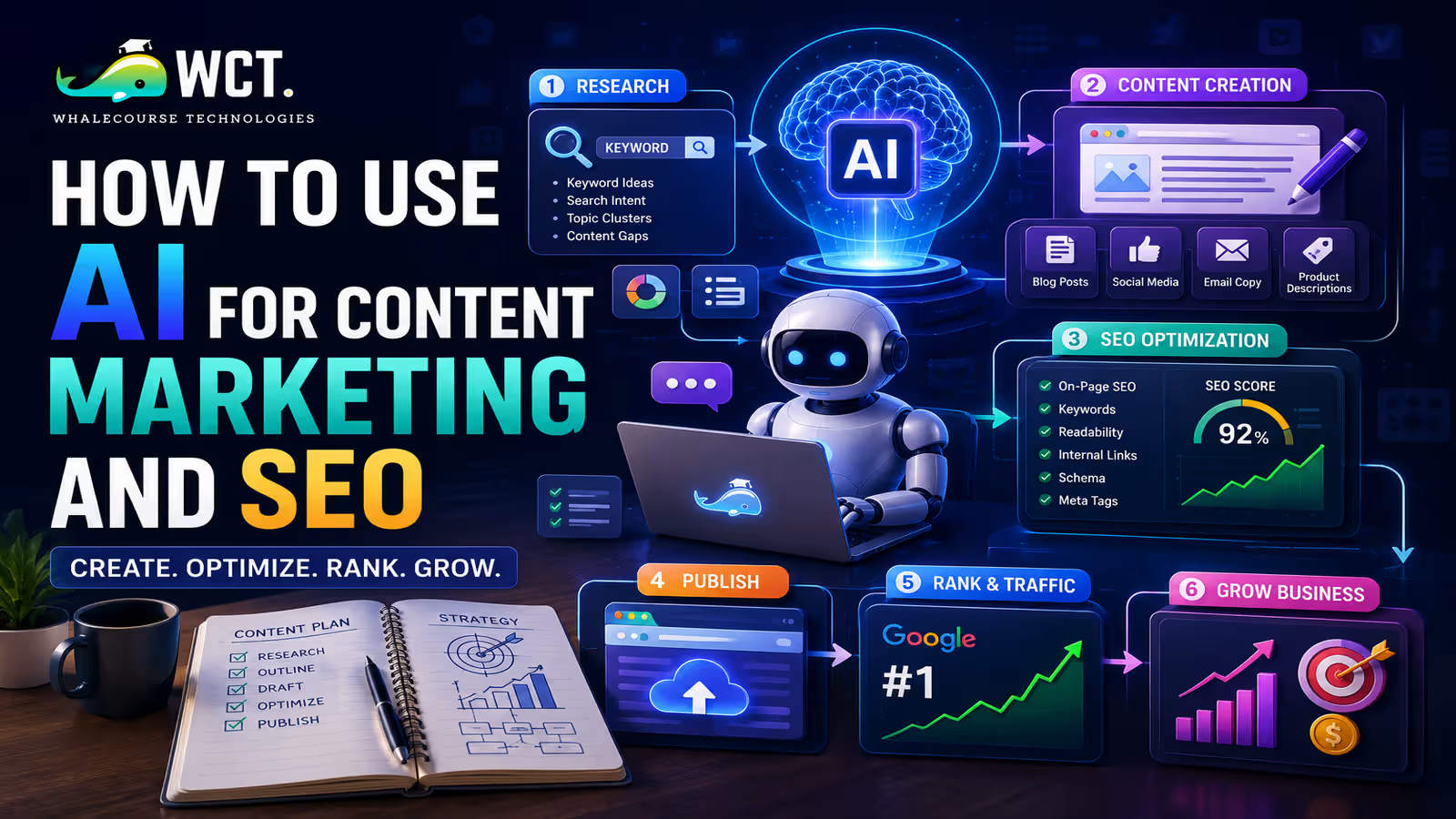
A practical AI-assisted content workflow looks like this. Start with keyword research using your SEO platform. Identify your target keyword and cluster related terms. Use an AI tool to generate a structured outline based on the keyword and the top-ranking pages for that query. Review the outline and add unique angles, personal insights, or original data that the AI cannot generate on its own.
Write the first draft using the AI as a co-writer. Prompt it section by section rather than asking for the entire article at once. This gives you more control over the tone and structure. Edit the draft heavily. Add examples, specific statistics, and genuine expertise. Run the draft through your SEO optimization tool and incorporate relevant semantic keywords where they fit naturally. Publish and track performance over the following three to six months.
This workflow consistently produces content that is both faster to create and better optimized than a purely manual approach, without sacrificing the editorial quality that both readers and search engines reward.
Limitations of AI in Content Marketing
AI tools hallucinate. They generate plausible-sounding content that is factually incorrect, sometimes without any obvious signal that something is wrong. Every factual claim in AI-generated content needs to be verified before publication. This is non-negotiable if you care about your brand’s credibility.
AI also cannot provide genuine first-hand experience. A travel article written by AI about visiting Tokyo lacks the sensory details, unexpected moments, and personal voice that make travel content memorable and trustworthy. For experience-driven content, AI can help with structure and supporting information, but the experiential core must come from a human.
Finally, over-relying on AI creates brand voice consistency problems. If multiple people on your team are prompting AI tools without clear editorial guidelines, your content can feel fragmented and impersonal. Establishing a brand voice document and using it as context in your AI prompts helps maintain consistency across a large content operation.
Start Your Digital Marketing Career Today
Join WhaleCourseTechnologies for affordable training with hands-on projects and placement support.
Conclusion
AI for content marketing is not a magic switch that suddenly doubles your traffic or eliminates the need for skilled writers. It is a set of tools that, used thoughtfully, makes your content team faster, your SEO research more data-driven, and your content optimization more systematic. The teams seeing the best results from AI in 2026 are the ones that treat it as a capability multiplier rather than a replacement for editorial expertise.
Start small. Pick one part of your content process — keyword clustering, meta description writing, or first-draft outlines — and introduce an AI tool there. Measure the time savings and quality impact. Then expand from that foundation. That measured approach consistently outperforms teams that try to automate everything at once and end up with a library of generic content that ranks for nothing and satisfies no one.
In This Article
Enroll in Our IT Courses
Master IT Program at whalecoursetechnologies
- Expert Mentorship from IT Professionals
- Job-Ready Skills with Live Projects
- Career Boost Add-on Modules
- 100% Placement & Interview Support