
How to Generate Leads Using Facebook Ads
Learning how to generate leads using Facebook Ads is one of the most valuable skills any business owner or digital marketer can develop. Facebook and Instagram together reach over three billion active users monthly. More importantly, Meta’s advertising platform offers targeting capabilities that no other channel can match — reaching specific demographics, interests, job titles, behaviors, and custom audiences built from your existing customer data. This guide covers every stage of a working lead generation system on Facebook Ads, from campaign setup to conversion optimization.
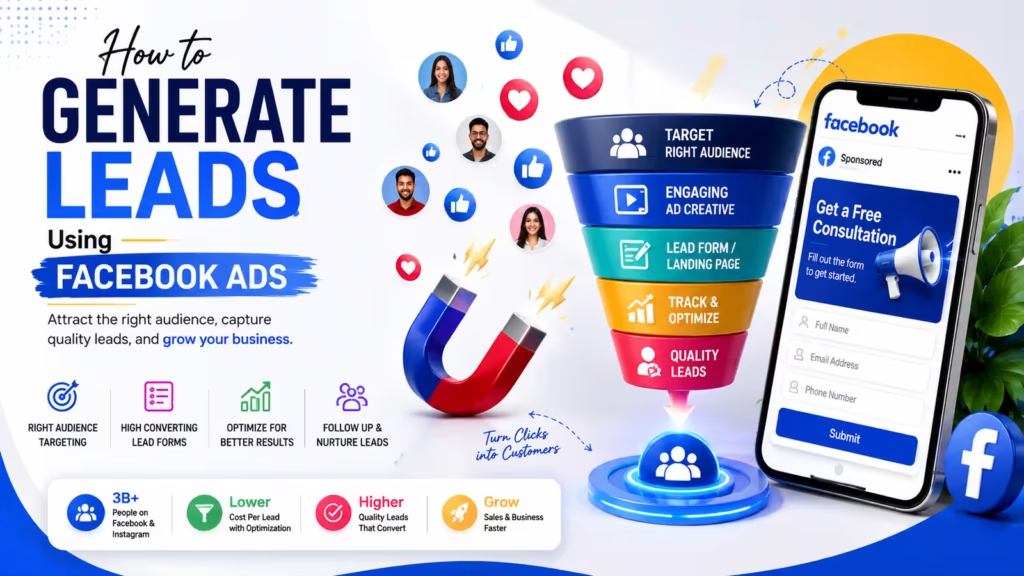
Understanding the Facebook Ads Lead Generation Objective
Facebook Ads Manager offers several campaign objectives. When your goal is to collect contact information from potential customers, you should use either the Leads objective or the Conversions objective. Understanding the difference helps you choose correctly.
The Leads objective uses Facebook’s native Instant Forms — forms that open directly inside Facebook or Instagram without requiring users to visit an external website. Because the forms pre-fill with data Facebook already has about the user, the friction is very low. Click-through rates tend to be high, but lead quality can vary because the process is so easy that some people submit without strong intent.
The Conversions objective sends users to a landing page on your website where they complete a form. This requires more effort from the user, which naturally filters out low-intent clicks. Lead quality from conversion campaigns is typically higher, but cost per lead is often higher too. The right choice depends on your sales process, your landing page quality, and how quickly your sales team can follow up with leads.
Setting Up Facebook Pixel Before You Spend a Rupee
The Facebook Pixel is a piece of code you install on your website that tracks visitor actions — page views, form completions, button clicks, and purchases. Without it, you cannot run effective conversion campaigns, you cannot build retargeting audiences from your website visitors, and you cannot create lookalike audiences based on customers who have already converted.
Install the Pixel before running any ads. Go to Events Manager in Meta Business Suite, create a new Pixel, and install it on every page of your website using the base code. Then set up conversion events to fire when specific actions happen — such as when a user lands on your thank-you page after submitting a lead form.
With conversion events properly configured, Facebook’s algorithm learns which users are most likely to convert and automatically finds more people like them. This learning process, called campaign learning phase, requires approximately fifty conversion events per ad set per week to work optimally. Plan your budget accordingly.
Audience Targeting: The Most Powerful Part of Facebook Ads
Facebook’s targeting options are what make it uniquely powerful for generating leads. You can reach people based on who they are, what they are interested in, and what actions they have taken on your website or with your content.
Interest-based targeting allows you to reach people who follow pages related to your industry, expressed interest in specific topics, or engaged with related content. This is the starting point for most campaigns when you have no existing audience data.
Custom Audiences let you upload a list of existing contacts — phone numbers or email addresses — and Facebook matches them to user accounts. You can then run campaigns specifically targeting your existing contacts, which is effective for re-engaging leads who did not previously convert.
Lookalike Audiences are one of the most powerful features for generating leads using Facebook Ads. You give Facebook a source audience — your customer list, your website converters, or your top-engaged followers — and Facebook finds new users who share similar characteristics. A one percent lookalike audience from converted customers consistently outperforms most interest-based targeting because it is built from real conversion data.
Retargeting reaches people who visited your website but did not submit a lead form. These users have already shown interest. Retargeting them with a follow-up message or a different offer is consistently one of the highest-performing strategies for lead generation campaigns.
Crafting Ad Creative That Generates Leads
Ad creative is what stops a user from scrolling past your ad. In Facebook’s feed, you have approximately one second to capture attention before a user moves on. The visual — image or video — carries most of that weight.
Video ads consistently outperform static images for lead generation because video builds trust and explains value more effectively. A fifteen to thirty second video that shows a real person explaining a specific problem your product solves and demonstrating the solution performs better than a polished brand video in most lead generation contexts. Authenticity tends to beat production value on social platforms.
Your ad copy should focus on a specific pain point your target audience faces, offer a clear benefit, and tell people exactly what to do — click to learn more, download the guide, get a free quote. Avoid vague calls to action like learn more or discover. Specificity converts better than curiosity in lead generation campaigns.
Test at least three to five creative variations per ad set when starting a new campaign. Let the data show you which combinations of headline, image, and copy generate the lowest cost per lead before scaling budget behind the winners.
Designing Your Lead Magnet Offer
Nobody gives away their phone number or email address for nothing. To generate leads using Facebook Ads effectively, you need a compelling offer that gives potential customers a reason to share their contact information. This is called a lead magnet.
Effective lead magnets solve a very specific problem quickly. A free guide, a discount code, a free consultation, a webinar registration, a quiz result, a free template, or a cost estimate calculator are all proven lead magnet formats. The best lead magnet is one that addresses the most pressing question your ideal customer has right now.
In education and training businesses, a free demo class or a career counselling session works exceptionally well because it connects directly to the decision the prospect is about to make. In e-commerce, a first-purchase discount code converts reliably because it removes the price objection at the most critical moment.
Your lead magnet should be immediately accessible. If someone fills out a lead form and then waits three days to receive what was promised, their trust in your brand drops before your sales conversation has even started.
Budget, Bidding, and Scaling Your Campaigns
Start Facebook lead generation campaigns with a modest daily budget — between three hundred and one thousand rupees per ad set — to gather enough data to make optimization decisions without overspending. Increase budget only after you have identified which audiences and creatives produce acceptable lead quality at an acceptable cost.
Use Advantage Campaign Budget — formerly known as Campaign Budget Optimization — to let Facebook automatically distribute budget toward the best-performing ad sets within a campaign. This works well once you have multiple tested ad sets running and want to let the algorithm allocate efficiently.
When scaling a campaign that is generating leads at a profitable cost, increase the budget by no more than twenty to thirty percent every two to three days. Increasing budget too aggressively resets the learning phase and can cause performance to temporarily drop while the algorithm recalibrates.
Key Metrics to Track for Facebook Lead Generation
| Metric | What It Measures | Benchmark |
|---|---|---|
| Cost Per Lead (CPL) | Total spend divided by leads generated | Varies by industry; track versus sales value |
| Click-Through Rate (CTR) | Percentage of impressions that result in a click | Above 1% is healthy for lead gen |
| Frequency | Average times a user saw your ad | Above 3-4 indicates audience fatigue |
| Landing Page Conversion Rate | Percentage of clicks that become leads | 10–30% is typical for lead gen pages |
| Lead Quality Rate | Percentage of leads that become sales conversations | Track from CRM data |
Common Mistakes That Waste Facebook Ads Budget
Understanding what not to do saves money faster than knowing what to do. These are the most common mistakes businesses make when trying to generate leads using Facebook Ads.
- Targeting too broadly — a national campaign targeting all adults aged eighteen to sixty-five for a local tutoring business wastes budget on people who will never convert. Geographic targeting and relevant interest filters are not optional.
- Sending ad traffic to the homepage — your homepage is built for multiple purposes. A dedicated landing page with one single goal — submit this form — converts dramatically better.
- Ignoring ad frequency — when the same users see your ad more than four times without converting, they become annoyed. Rotate creative regularly to keep campaigns fresh.
- Making too many changes too quickly — every significant change to an ad set resets the learning phase. Make one change at a time and give campaigns at least five to seven days before judging performance.
- Not following up on leads fast enough — research consistently shows that contacting a lead within five minutes of submission increases conversion dramatically. Delayed follow-up is where most lead generation ROI is lost.
Connecting Facebook Leads to Your CRM
Manually downloading lead data from Facebook Ads Manager every day and importing it into a spreadsheet or CRM is a process that breaks down quickly as lead volume grows. Automating lead delivery ensures your sales team receives fresh leads immediately and never misses a follow-up opportunity.
Most popular CRM systems — HubSpot, Salesforce, Zoho CRM, and Leadsquared — offer native Facebook Lead Ads integration. Once connected, new leads flow directly into your CRM within minutes of submission. Your team receives automated notifications, and the lead enters your sales pipeline immediately without manual intervention.
If your CRM does not have a native Facebook integration, Zapier and Make (formerly Integromat) can create automated workflows that connect Facebook Lead Ads to virtually any software system. Setting up this automation before launching your campaign is part of a professional lead generation setup.
Start Your Digital Marketing Career Today
Join WhaleCourse Technologies for affordable training with hands-on projects and placement support.
Conclusion
Generating leads using Facebook Ads is a learnable, repeatable process. It requires the right objective, proper Pixel tracking, thoughtful audience targeting, a compelling offer, and creative that captures attention in a crowded feed. None of these elements work in isolation — the whole system needs to function together for campaigns to deliver consistent results.
Start with a clear understanding of who your ideal customer is and what problem you are solving for them. Build your campaign structure around that understanding. Test methodically. Let data guide your optimization decisions rather than instinct alone. And ensure your follow-up process is ready before you spend the first rupee — because the best ad campaign in the world cannot compensate for slow or weak follow-up once a lead is captured.
The businesses that generate leads most effectively on Facebook are not necessarily those with the largest budgets. They are the ones who understand their audience deeply, test consistently, and optimize relentlessly based on what the data shows.
In This Article
Enroll in Our IT Courses
Master IT Program at whalecoursetechnologies
- Expert Mentorship from IT Professionals
- Job-Ready Skills with Live Projects
- Career Boost Add-on Modules
- 100% Placement & Interview Support