
Top SEO Trends You Must Follow in 2026
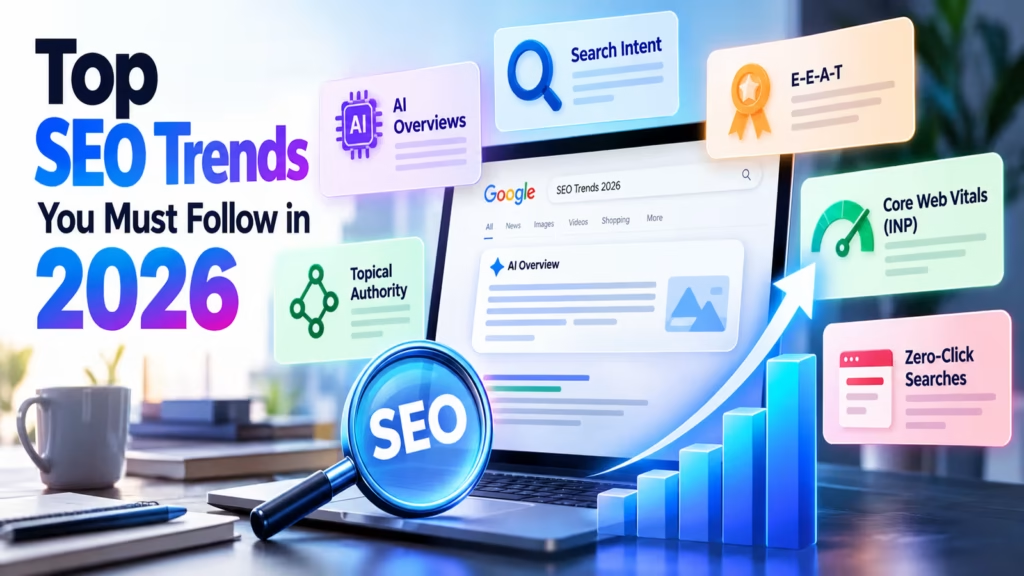
Search engine optimization is moving faster than most teams can keep pace with. The signals Google and other search engines weight most heavily have shifted significantly, and strategies that worked reliably in 2023 are producing diminishing returns. Understanding which SEO trends in 2026 genuinely matter — and which are noise — is the difference between maintaining organic visibility and losing ground to competitors who have adapted. This article covers the most important developments shaping search in 2026, with practical context for each one.
AI Overviews Are Changing How Traffic Works
Google’s AI Overviews now appear for a substantial portion of searches. These AI-generated answer blocks pull information from multiple sources and display it directly on the results page, often before users scroll to the traditional organic listings.
The practical effect is that click-through rates for informational queries have declined in many niches. However, sites that are cited inside AI Overviews gain significant implied authority — and some of those citations do drive traffic, particularly for commercial and comparison queries where users want more detail than the summary provides.
To increase your chances of being cited, structure your content around clear, direct answers. Use precise entity names and define technical terms within the same paragraph. Write in a way that makes it easy for AI systems to extract a single authoritative statement. Vague, hedged content is rarely cited.
Search Intent Has Become Non-Negotiable
Google’s systems have grown considerably better at identifying whether a page actually satisfies the intent behind a query — not just whether it contains the matching keywords. Ranking a well-optimized page that answers the wrong version of a question has become much harder.
Before creating any content in 2026, search the target query and examine what Google is currently ranking. If the first page is dominated by comparison articles, Google has determined that the intent is commercial investigation. Publishing a long-form beginner guide for the same query will not rank well regardless of its quality, because the format mismatches what users want.
Intent alignment is especially important in discussions about SEO trends 2026 because the landscape itself shifts quickly. Pages that matched intent two years ago may no longer be relevant to what users expect to find.
E-E-A-T Signals Are More Visible Than Ever
Experience, Expertise, Authoritativeness, and Trustworthiness — collectively known as E-E-A-T — continue to be central to how Google evaluates content quality. Google’s quality raters use these criteria to assess whether a page deserves to rank for queries where accuracy matters.
In 2026, websites publishing YMYL content (Your Money or Your Life — finance, health, legal, safety) face especially high scrutiny. Named authors with verifiable credentials, clear sourcing, and transparent editorial processes are not optional in these categories — they are baseline requirements. Sites without these signals consistently struggle in post-update recoveries.
Core Web Vitals: INP Has Changed the Conversation
Interaction to Next Paint replaced First Input Delay as a Core Web Vital in 2024, and its effects continue into 2026. Sites carrying heavy third-party scripts, unoptimized JavaScript, and excessive animations are seeing measurable ranking disadvantages on competitive queries where margins are thin.
Technical performance does not guarantee rankings, but poor performance creates a ceiling. If two pages are equally relevant and authoritative, the faster one has the edge. The same logic applies to mobile usability — Google indexes mobile-first, and desktop-only optimizations miss most of the modern search audience.
Zero-Click Searches: How to Optimize for More Visibility
A zero-click search occurs when Google answers a query directly on the results page — through a featured snippet, Knowledge Panel, AI Overview, or a calculated result — and the user has no reason to click through. These searches have grown considerably.
The response is not to avoid optimizing for these features, but to choose query types carefully. Zero-click queries are usually simple factual questions. Complex, nuanced topics — comparisons, how-to processes, strategic decisions — still drive meaningful clicks because users need more than what fits in a snippet. Invest content effort where user intent demands depth.
Topical Authority Over Keyword Coverage
Publishing one comprehensive article per keyword is no longer sufficient. Google evaluates a site’s overall depth of coverage on a subject — not just the quality of individual pages. A site that covers every meaningful angle of a topic signals domain expertise in a way that isolated articles cannot.
This is topical authority, and it explains why newer, smaller sites are increasingly outranked by older sites with extensive related content, even when individual articles on the smaller site are better written. Building content clusters — a pillar page surrounded by supporting articles covering related subtopics — is now standard practice among competitive SEO teams.
Voice and Conversational Search Optimization
The growth of AI assistants and voice-enabled devices has made conversational search patterns more prominent. Users ask longer, more natural questions rather than typing compressed keyword strings. This changes the vocabulary that content must address.
Optimizing for conversational search means writing in natural language, answering specific questions within the body of an article, and using structured headings that closely match how people actually phrase their queries. Schema markup — particularly FAQ, HowTo, and Article schema — helps search engines parse content structure and increases the chances of appearing in voice and AI-powered results.
This is one of the most practical SEO trends in 2026 for content teams to act on immediately, since it primarily requires adjusting how content is written rather than overhauling technical infrastructure.
Link Building Quality Standards Have Risen
Backlinks remain one of the strongest ranking signals, but accumulating large volumes of low-quality links is definitively over. Google’s link spam systems have grown considerably more effective at identifying and discounting links acquired through private blog networks, paid link schemes, and low-quality directory submissions.
What works in 2026 is earning links from genuinely authoritative, relevant sources. Original research, unique datasets, practical tools, and deeply expert content attract natural backlinks from publications that want to cite reliable sources. Guest posting on reputable industry publications with actual editorial standards still produces value. A smaller number of high-quality links from authoritative domains will consistently outperform hundreds of links from sites with no real audience or topical relevance.
Video SEO Is No Longer Optional for Many Industries
Google continues to give significant search real estate to video content. YouTube videos appear prominently in web search results, and for queries where users clearly prefer a visual demonstration — tutorials, product reviews, setup guides — video content consistently captures clicks that text alone cannot.
Video SEO in 2026 means optimizing titles, descriptions, chapters, and transcripts on YouTube, using proper schema markup for video content embedded on web pages, and building pages where video complements written content rather than replacing it. Sites that integrate both formats well have a structural advantage in SERP coverage.
Local SEO in an AI-Driven Search Environment
For businesses with physical locations or service areas, local SEO remains one of the highest-ROI channels available. The Google Business Profile continues to be the most important local ranking factor, and AI Overviews have begun incorporating local business information for near-me queries.
Review velocity and recency matter more than review count alone. A business with 50 reviews in the past six months outperforms one with 300 reviews from three years ago in many local search scenarios. Accurate, complete, and well-reviewed Business Profile data is not optional — it is the foundation of local visibility.
Structured Data and Schema Markup
Schema markup tells search engines exactly what your content is about without requiring them to infer meaning from text. In 2026, structured data has expanded in importance because AI systems use it to identify authoritative sources for specific types of information.
Common schema types that provide measurable benefits include Article, Product, Review, HowTo, FAQ, Event, and Recipe markup. Each enables specific rich result formats in search, which increase click-through rates and visibility. Sites without structured data are relying entirely on Google’s ability to infer context — structured data removes that uncertainty.
Implementing and auditing schema markup is one of the most technically underutilized SEO opportunities remaining in competitive markets. Many sites have partially implemented schema with errors that prevent rich results from generating — a targeted audit often reveals straightforward, fixable problems that produce immediate gains.
Start Your Data Analytics Career Today
Join WhaleCourseTechnologies for affordable training with hands-on projects and placement support.
Conclusion
The SEO trends shaping 2026 reflect a maturing search ecosystem where genuine quality, clear relevance, and technical soundness have become the dominant ranking factors. AI Overviews have changed how traffic flows from informational queries. Intent alignment separates pages that rank from those that do not. E-E-A-T signals determine whether high-stakes content is trusted. Topical authority rewards sites that invest in depth over breadth.
The teams seeing the best results are not chasing each algorithm update individually. They are building content that genuinely serves readers, maintaining clean technical foundations, earning legitimate backlinks, and structuring their sites so that search engines can clearly understand what each page is about. That approach has been consistent for years — what has changed is that there are fewer shortcuts that temporarily work around it.
In This Article
Enroll in Our IT Courses
Master IT Program at whalecoursetechnologies
- Expert Mentorship from IT Professionals
- Job-Ready Skills with Live Projects
- Career Boost Add-on Modules
- 100% Placement & Interview Support
