
Google Ads vs Facebook Ads: Which Is Better for Businesses?
Google Ads vs Facebook Ads is a key decision that many business owners and digital marketing professionals face when choosing the best platform for their advertising budget. Both platforms drive significant revenue for millions of businesses, but they operate on fundamentally different principles. Understanding those principles — not just comparing costs or audience sizes — is what leads to smart allocation decisions that actually improve your return on ad spend.
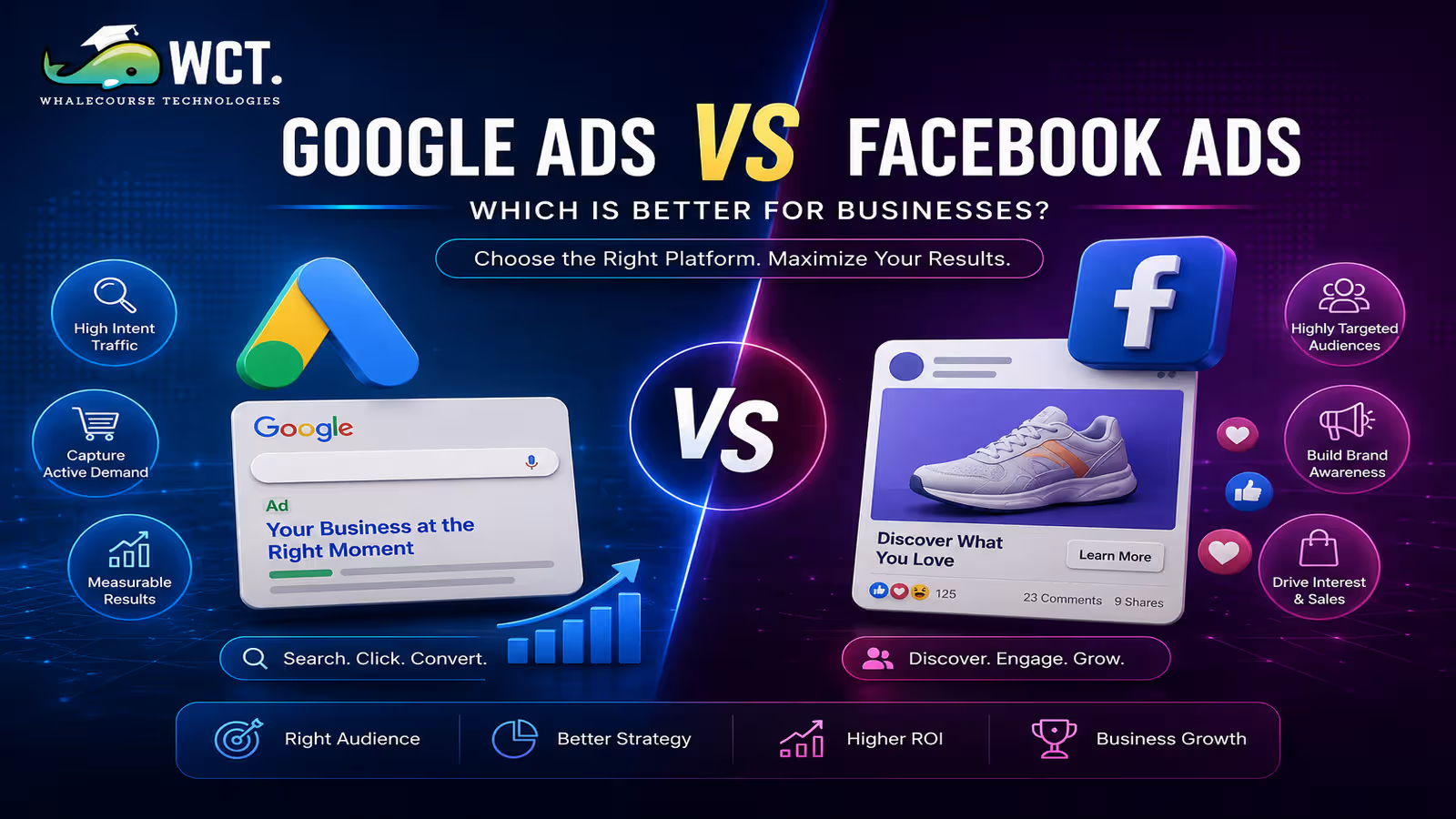
The Core Difference: Intent vs Interest
Google Ads primarily captures search intent. When someone types a query into Google, they are actively looking for something. Your ad appears at the moment of demand. This makes Google Ads exceptionally powerful for products and services that people already know they need and are actively searching for — plumbing services, software tools, specific products, local restaurants, legal services.
Facebook Ads operate differently. They target people based on interests, demographics, behaviors, and life events — not search queries. Your ad appears in someone’s feed while they are scrolling through content they were not actively searching for. This is often called interruption marketing or demand generation. It works best for products and services where awareness-building precedes purchasing consideration.
Understanding this distinction is the most important frame for the entire Google Ads vs Facebook Ads comparison. The right platform is the one that matches your customer’s buying stage, not the one with the bigger audience or the lower cost-per-click.
How Targeting Works on Each Platform
Google Ads targeting is built around keywords, audience segments, and contextual signals. You bid on search terms that trigger your ad. You can layer demographic data, device type, location, and time of day on top of keyword targeting to refine who sees your ad and when. Google’s Performance Max campaigns now use AI to optimize targeting across Search, Display, YouTube, Gmail, and Shopping from a single campaign, reducing manual setup significantly.
Facebook Ads targeting is built around Meta’s first-party data from Facebook and Instagram. You can target by age, gender, location, language, interests (what people follow and engage with), behaviors (purchase history, device usage, travel habits), and custom audiences built from your own customer lists or website visitors through the Meta Pixel. Lookalike audiences let you find new users who match the profile of your existing best customers.
A major change by 2026 is that Facebook’s interest-based targeting is no longer as accurate as it was several years ago, mainly because privacy updates introduced with iOS 14 and later changes reduced the amount of app-level tracking available. Conversion-based campaigns using your own first-party data now perform more reliably than broad interest targeting alone.
Cost Comparison: CPC, CPM, and Budget Efficiency
Cost comparisons between the two platforms need context to be meaningful. Average cost-per-click on Google Ads varies enormously by industry — from under one dollar for some entertainment queries to forty or fifty dollars for competitive legal and financial services keywords. The average across all industries in 2026 sits roughly between two and five dollars per click for search campaigns.
Facebook Ads average CPC is generally lower, often between one and two dollars for many industries. However, the conversion rate from Facebook clicks is often lower than from Google search clicks because the traffic is less intent-driven. A lower CPC with a lower conversion rate can easily produce a higher cost-per-acquisition than a more expensive Google click from a high-intent searcher.
Always calculate cost-per-acquisition rather than cost-per-click when comparing platform efficiency for your specific business. The most efficient platform is whichever one delivers customers at the lowest cost, not whichever one delivers clicks most cheaply.
Ad Formats and Creative Requirements
Google Search Ads are primarily text-based. Your headline, description, and URL are the creative elements. Success depends on copywriting quality and keyword relevance more than visual design. Google Display and YouTube ads do use visual creative, but search remains the dominant channel for most small and mid-sized businesses.
Facebook Ads are fundamentally visual. Image ads, video ads, carousel ads, Stories, and Reels all compete for attention in a visually rich feed environment. Strong creative — compelling images or videos with clear messaging — is the single biggest driver of Facebook Ad performance. A technically well-targeted campaign with weak creative will consistently underperform a broader campaign with scroll-stopping visuals.
This means businesses with strong visual identity and creative capacity tend to get more from Facebook Ads. Businesses with strong copy and keyword strategy tend to get more from Google Ads.
Which Businesses Benefit Most from Google Ads
Google Ads tend to deliver the strongest results for businesses where customers are actively searching for a specific solution. Local service businesses — plumbers, dentists, electricians, lawyers, real estate agents — consistently find high returns from Google Search campaigns because the people clicking the ads have high purchase intent right now.
B2B software and SaaS companies also perform well on Google Ads because business buyers use Google to research tools before making purchasing decisions. Searches such as “best CRM software for small business” or “project management tool for remote teams” often attract users with strong buying intent, making them highly likely to convert when supported by relevant Google Ads and optimized landing pages.
E-commerce businesses selling products that people actively search for by name or category — running shoes, baby monitors, protein supplements — also find Google Shopping campaigns highly effective for driving purchase-ready traffic.
Which Businesses Benefit Most from Facebook Ads
Facebook Ads excel for businesses selling products or services that benefit from visual storytelling, lifestyle positioning, or impulse purchasing. Fashion brands, fitness products, subscription boxes, online courses, beauty brands, and consumer apps all find Facebook Ads a powerful primary channel because their customers respond to seeing the product in use before feeling the need to search for it.
Facebook is also strong for retargeting — showing ads to people who have already visited your website, watched a video, or interacted with your content. Because these audiences have already shown some interest in your brand, retargeting campaigns typically achieve much higher conversion rates than cold prospecting campaigns. This makes Facebook Ads an effective complement to any channel that drives initial traffic, including Google Ads and organic search.
Event promotion, community-based businesses, and local brick-and-mortar retailers also benefit from Facebook’s demographic and location targeting, especially for building brand awareness in a defined geographic area over time.
Measuring Performance: Key Metrics to Track on Each Platform
Tracking the right metrics on each platform prevents you from optimizing for vanity numbers instead of business outcomes.
For Google Ads, the core metrics are click-through rate (CTR), conversion rate, cost-per-conversion, quality score, and return on ad spend (ROAS). Quality score is particularly important because it directly affects how much you pay per click — ads with higher quality scores get the same position for less money. A quality score below 5 on any keyword warrants attention to ad relevance and landing page experience.
For Facebook Ads, the key metrics are cost-per-1000-impressions (CPM), click-through rate, cost-per-result, frequency, and ROAS. Frequency — how many times on average each person has seen your ad — deserves close attention. When frequency climbs above four or five, creative fatigue sets in and your cost-per-result typically rises sharply. Rotating creatives regularly prevents this.
Running Both Platforms Together: The Full-Funnel Approach
The Google Ads vs Facebook Ads framing assumes you have to choose one. For many businesses with sufficient budget, running both simultaneously across different funnel stages produces substantially better results than either platform alone.
A practical combined strategy looks like this: use Facebook Ads at the top of the funnel to build brand awareness and drive initial website visits among cold audiences. Use Google Ads to capture the intent-driven demand that your Facebook campaigns and organic content have generated. Use Facebook retargeting to re-engage website visitors who did not convert after their first visit. Use Google remarketing lists for search ads (RLSA) to bid more aggressively on search queries from people who have already visited your site.
This approach works because the two platforms reinforce each other. Facebook warms up cold audiences; Google captures them when they are ready to buy. Businesses that implement this full-funnel structure consistently outperform those that split-test the two platforms in isolation and declare a winner based on last-click attribution alone.
Common Mistakes That Waste Ad Budget on Both Platforms
Regardless of which platform you choose, specific mistakes consistently destroy campaign performance and waste budget.
- Sending ad traffic to your homepage — A landing page built specifically for the ad offer usually converts far better than a general homepage, helping more users complete the intended action. Every significant ad campaign needs its own dedicated landing page.
- Running ads without conversion tracking — Campaign performance cannot be improved without accurate data. Both platforms need proper tracking configured and tested before investing a significant advertising budget. Google Tag Manager and Meta Pixel need to be correctly implemented and verified before campaigns launch.
- Setting budgets too low to generate data — Facebook’s algorithm needs approximately 50 conversion events per week to exit the learning phase and optimize effectively. Running campaigns at twenty dollars per day and expecting meaningful results in a week is a common beginner mistake.
- Ignoring ad scheduling and device targeting — Many businesses have significantly different conversion rates by day of week, time of day, and device type. Analyzing this data and adjusting bids or budgets accordingly is one of the highest-leverage optimizations available on both platforms.
How to Choose Based on Your Business Type
If budget forces you to choose one platform to start, here is a straightforward decision framework based on business type.
- Start with Google Ads if you sell products or services people actively search for, if you are a local service business, if your sales cycle is short, or if your average transaction value is high enough to sustain competitive keyword bids.
- Start with Facebook Ads if you sell products that benefit from visual demonstration, if you have a clearly defined audience demographic you can target by interest, if your product requires building awareness before demand, or if you have strong visual creative assets ready to use.
- Use both if your monthly digital ad budget exceeds five hundred to a thousand dollars and you have proper tracking in place to measure performance accurately on each platform.
The Real Answer to the Google Ads vs Facebook Ads Question
Neither platform is universally better for businesses. The right answer depends entirely on your customer’s buying journey, your product category, your creative capabilities, and your available budget. Google Ads wins when your customers are actively searching for what you sell. Facebook Ads win when you need to reach people before they know they need you, or when your product sells on visual appeal and social proof.
The businesses that consistently achieve the best results from digital advertising are not those that find the “best” platform — they are those that understand their customer’s decision-making process deeply and build campaigns that meet customers at exactly the right moment in that journey, on whichever platform that moment occurs.
Start Your Data Analytics Career Today
Join WhaleCourseTechnologies for affordable training with hands-on projects and placement support.
Conclusion
Google Ads and Facebook Ads are both excellent tools used by successful businesses across every industry. The Google Ads vs Facebook Ads debate is not really about which platform wins — it is about understanding what each platform is designed to do and matching that to your specific marketing objectives.
Start by clearly defining what stage of the buying journey you are trying to influence. Then build campaigns on the platform that matches that stage, with the right creative format and a proper measurement framework in place. Revisit your platform mix every quarter as your data grows and your understanding of your customer’s path to purchase deepens. That iterative approach consistently outperforms any fixed-platform commitment made before the data is in.
In This Article
Enroll in Our IT Courses
Master IT Program at whalecoursetechnologies
- Expert Mentorship from IT Professionals
- Job-Ready Skills with Live Projects
- Career Boost Add-on Modules
- 100% Placement & Interview Support